
Kalawao County Court Records After Arrest
Court records after a Kalawao County arrest are not the same as arrest records, custody records, or booking photos. The arrest may involve a statutory Kalawao sheriff role, deputized officers, Maui mutual-aid support, or another agency. Once the prosecution files charges, the public case record is searched through the Hawaii Judiciary. That court record is where the filed offenses, case status, hearings, bail or bond information, and dockets appear.
For live custody, use Kalawao County inmate records and DCR/SAVIN. For booking-photo questions, use Kalawao County jail mugshots and agency UIPA paths. For the court records after jail arrest, start with eCourt Kokua, then contact the proper court clerk or legal documents office when an older, sealed, or non-online document is needed.
Search eCourt Kokua by Name
The Hawaii Judiciary eCourt Kokua access page is the central public case-search route for court records after an arrest. A name search is the usual starting point when no case number is known. Search results and case screens may include a case description, parties, events, dockets, offenses, bail or bond information, and upcoming hearings. Sealed or confidential records may be masked or unavailable online.
- Open eCourt Kokua and choose the person-search option.
- Search by first and last name, using exact spelling when known.
- Use phonetic or partial search options when spelling is uncertain.
- Open the criminal case and review Summary, Parties, Bail/Bond, Events, Dockets, and Offenses.
- Use the court location and case ID when calling the clerk or requesting documents.
The manifest capture for the Hawaii Judiciary eCourt Kokua access page shows the official case-search availability route for Kalawao County court records after a jail arrest.
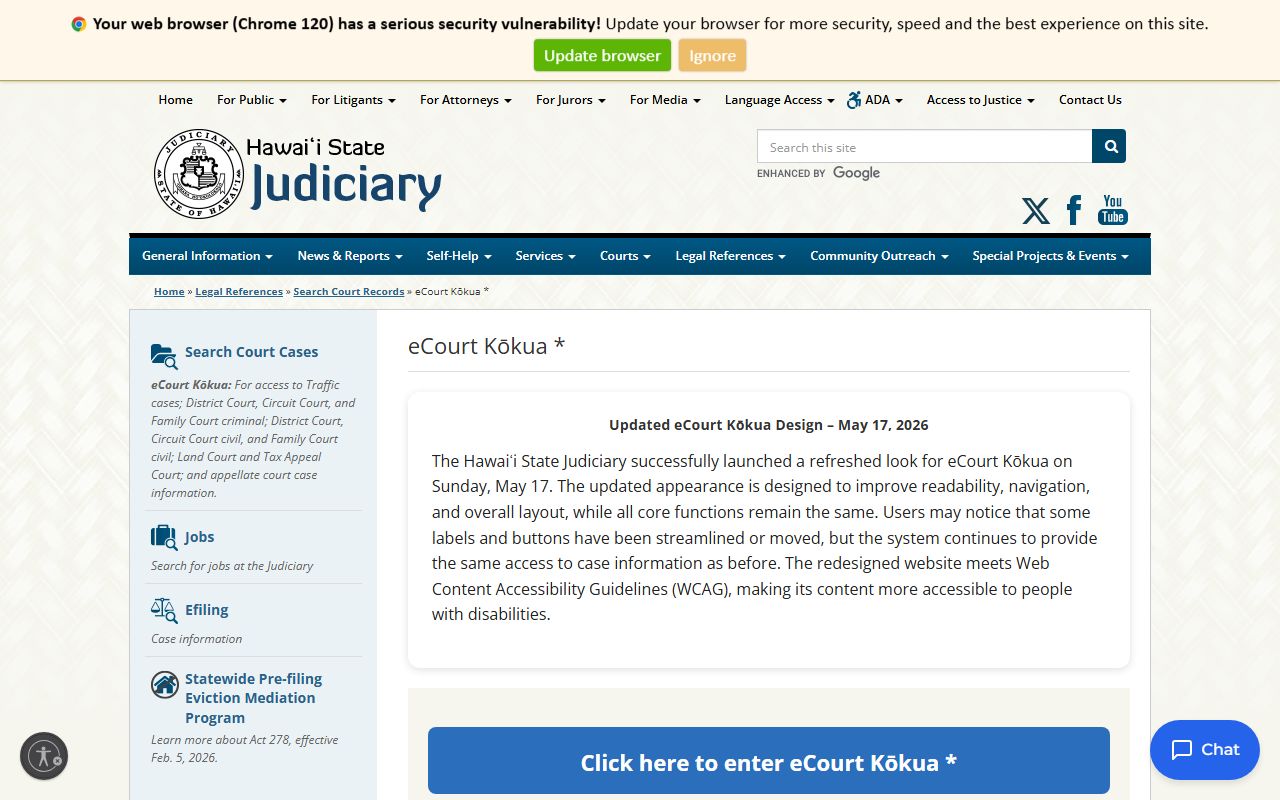
The screenshot belongs here because the court case, not the missing county roster, is the record source for filed charges and hearing activity after arrest.
Search by Case ID or Arrest Number
The official eCourt Kokua user manual lists several search fields that can narrow court records after a jail arrest. Case ID, arrest number, OTN, SID, filing date, and hearing calendar fields can help when a name search is too broad. The Second Circuit digit can matter for older migrated case numbers, and filing-date searches may have date-range limits.
| Field | Use | Notes |
|---|---|---|
| Person First and Last Name | Defendant or party search | Minimum fields for most person searches. |
| Phonetic / Partial Search | Spelling help | Useful for uncertain names. |
| Case ID | Direct case lookup | Older migrated cases may require circuit digit and leading zeroes. |
| Arrest Number, OTN, SID | Post-arrest identifiers | Helpful when law-enforcement or court identifiers are known. |
| Filing Date Range | Recent filing search | Manual notes filing-date search limits. |
| Court, Location, Room, Calendar Date | Hearing search | Finds court calendars and hearing schedules. |
| Printable View | PDF-style output | Available for some search results. |
When a case is not visible online, the reason may be ordinary timing, an older paper or migrated record, a sealed matter, a confidential docket entry, or a search mismatch. Search by name first, then by case ID or arrest identifier if known. If the docket shows a public PDF icon, documents may be purchasable through the system. If no PDF appears, the document may still be available from the clerk or legal documents office unless access is restricted.
Kalawao Second Circuit Court Route
The Hawaii Judiciary court structure places trial courts within circuits. The research notes that the Second Circuit covers Maui, Molokai, Lanai, Kahoolawe, and Molokini. Kalawao is on the Kalaupapa peninsula of Molokai, so practical court routing appears through the Second Circuit and Molokai court structure rather than a separate Kalawao courthouse workflow.
Molokai District Court
P.O. Box 284
55 Makaena Street
Kaunakakai, Molokai, HI 96748
(808) 553-1100
Second Circuit Legal Documents
For non-confidential Circuit Court criminal and civil document requests.
(808) 244-2969
Charging Documents After Arrest
After an arrest, the court record begins with a charging document or other case-opening filing. The exact document depends on the offense, prosecutor action, and court process. The public should read the filed court charge, not just the arrest allegation, because charges can be amended, reduced, dismissed, or replaced as the case moves.
| Document | Who Uses It | What It Means |
|---|---|---|
| Complaint | Prosecution or law-enforcement-supported filing | A charging document that can start a criminal case. |
| Information | Prosecutor | A prosecutor-filed charge document used in criminal cases. |
| Indictment | Grand jury process | A formal charge returned through grand-jury review. |
Charges Versus Convictions
A court record after a Kalawao County arrest can show charges before it shows a conviction. A charge is an accusation filed in court. A conviction is the result of a plea, verdict, or other case outcome. This distinction matters for background checks, public-record requests, eCrim searches, and expungement, because Hawaii's public adult conviction records are not the same as pending or non-conviction arrest records.
| Charge | Conviction | |
|---|---|---|
| Stage | Filed accusation in court | Case outcome after plea or verdict |
| Can change? | Yes, it may be amended, reduced, or dismissed | Changes only through later legal action |
| Where to check | eCourt Kokua case record | eCourt Kokua and HCJDC/eCrim where public |
| Custody meaning | May affect bail and detention | May affect sentence and DCR placement |
Bail and Bond Court Records
eCourt Kokua includes a Bail/Bond Information tab when case data is available. Hawaii bail is governed by HRS Chapter 804. HRS 804-4 says bail may be available before conviction when allowable, and HRS 804-9 says bail must be reasonable with attention to the offense, possible punishment, and the defendant's financial ability. A hold or detainer can still prevent release even when one case appears eligible for bail.
| Release Term | Plain Meaning |
|---|---|
| Cash bail | Money posted to secure appearance, subject to court and facility instructions. |
| Surety bond | A bond arrangement through a surety when allowed and accepted. |
| Own recognizance | Release without upfront cash under court-ordered appearance conditions. |
| Supervised release | Release with supervision or program conditions. |
| Conditional release | Release with specific conduct or contact limits. |
| No bail or detention | Custody remains when bail is denied, revoked, or not legally available. |
| Hold or detainer | Another agency or case may block release. |
Warrants After Kalawao Arrest
No official public Kalawao warrant list or statewide Hawaii public warrant-search portal was found. The Judiciary has an electronic bench-warrant system, but the research identifies it as law-enforcement-facing, not a public lookup. eCourt Kokua may still show status, events, or docket text tied to failure to appear, bench warrant activity, or later hearings.
- Search eCourt Kokua by name and case ID if known.
- Review events, status, upcoming hearings, and dockets for warrant or failure-to-appear language.
- Contact Molokai District Court or Second Circuit Legal Documents for case-record questions.
- Use DLE or Sheriff Division contacts if the record appears tied to statewide warrant service.
- Check DCR/SAVIN if the person is already in custody and a hold may affect release.
Sealed and Expunged Arrest Records
Hawaii public access is broad but not unlimited. HRS 92F-11 opens government records unless access is restricted, and HRS 92F-13 lists exceptions for privacy, prosecution, legitimate government function, and records protected by law or court order. HRS 831-3.2 governs qualifying expungement orders for arrest records.
| Sealed | Expunged | |
|---|---|---|
| Public visibility | Hidden or restricted from public access | Qualifying arrest record is annulled, canceled, or rescinded |
| Where handled | Court or agency process | HCJDC expungement process under Hawaii law |
| Online effect | May mask dockets or documents | May require withholding records tied to the expunged arrest |
The HCJDC expungement page identifies Form HCJDC 159(b), first-time and subsequent application fees, cashier's check or money order payment, and a 120-day processing time. Effective July 1, 2025, HCJDC says expungement orders are automatically sent to the Judiciary for consideration under HRS 831-3.2(f).
Kalawao Prosecutor Routing Caveats
The Maui County Department of the Prosecuting Attorney says it serves Maui, Molokai, and Lanai and prosecutes state and Maui County criminal and traffic-law violations. The official page did not explicitly mention Kalawao County. Because of Kalawao's unusual DOH-controlled structure, the case record should be used to confirm the prosecutor or agency assigned to a specific matter.
The Maui prosecutor contact page lists the Department of the Prosecuting Attorney at 150 S. High Street, Old Courthouse, Wailuku, HI 96793, phone (808) 270-7777, and fax (808) 270-7625. The Hawaii Attorney General Criminal Justice Division may be relevant for statewide, state-agency, conflict, multi-county, or special prosecutions. Do not assume a separate Kalawao prosecutor office exists unless the court record names one.
For adult conviction information after a case ends, the Hawaii eCrim portal and HCJDC public access process are separate from eCourt Kokua. eCrim is not a live custody locator and does not publish pending non-conviction arrest data as a general public record. Use it only for the conviction-record question it is designed to answer.
Kalawao's size and governance make assumptions risky. The court record is the best source for the actual prosecutor, charge, court, and next event in a specific case. If a reader only has a name and arrest date, start with eCourt Kokua, then use the court contact, prosecutor contact, or agency records request that matches the case information found there.
Do not treat a missing court result as proof that no arrest occurred. The case may not be filed yet, may be sealed, may use a different spelling, or may belong to a federal system.